
 Lamborajo Editorial Desk
 On this page
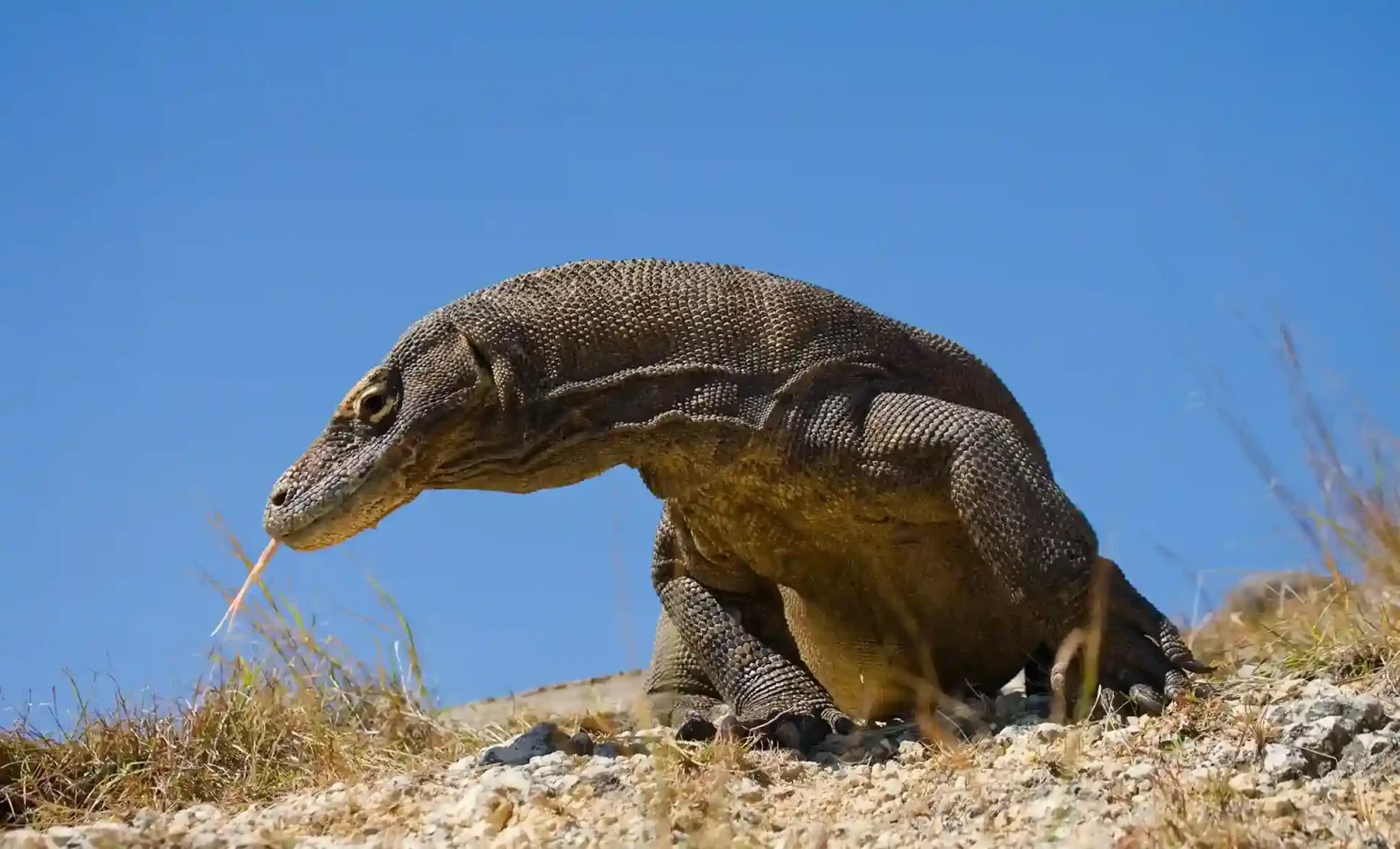
Both work. Rinca is closer to Labuan Bajo, its terrain is open, and sightings there are frequent because dragons gather near the ranger station and water points. Komodo Island is the larger, wilder population and the one most itineraries pair with Pink Beach. Neither can guarantee a sighting — these are wild animals in a park of roughly 1,817 square kilometres.
The choice is usually made for you by the itinerary rather than by preference, and that is fine, because the difference is smaller than the internet suggests. What is worth knowing is why an operator picks one over the other on a given day, and what the walk actually involves once you are ashore.
Komodo Island or Rinca: where do you actually see the dragons?
| Rinca | Komodo Island | |
|---|---|---|
| Position on the route | Closer to Labuan Bajo; often day one or the return leg | Deeper into the park; usually day two, after Padar and Pink Beach |
| Terrain | Open savannah, low hills, sparse trees | Mixed forest and savannah, larger scale |
| Sighting reliability | High — dragons congregate near the ranger station and water | High on ranger-led trails, more spread out |
| Trek length options | Short, medium and long loops | Short, medium and long loops |
| Typical time ashore | ~1–1.5 hours | ~1–1.5 hours |
| Other wildlife | Timor deer, wild boar, macaques, buffalo, many birds | Deer, boar, macaques, birds; larger forest tracts |
| Pairs naturally with | Kalong bat anchorage, Kelor | Pink Beach, Taka Makassar, Manta Point |
| Crowd | Busy at midday when day boats arrive | Busy mid-morning |
Operators substitute one for the other routinely, and it is not a downgrade. Wind direction, the anchorage, the tide window for the manta channel and how many boats are already at a landing all feed into the decision. On our standard route, Komodo sits on day two between Pink Beach and Taka Makassar, and Rinca replaces it when conditions favour the northern approach — both versions appear in our 3D2N itinerary.
What the trek is actually like
You land by tender, register at the ranger post, pay the ranger and trail charge, and are assigned a ranger who carries a forked stick. You cannot walk unaccompanied on either island. Groups are kept small enough to manage, and the ranger sets the pace and the distance — short, medium or long loop, chosen at the post.
The short loop takes about half an hour to forty-five minutes on flat ground and is what most boat groups do. The medium loop climbs a low ridge for a viewpoint and takes over an hour. The long loop is a genuine walk in heat with little shade, and it is not the better choice simply because it is longer; dragons are most reliably found near the ranger station and the water points, which the short loop already covers.
Expect it to be hot. Both islands are dry savannah for most of the year, the trails have almost no cover, and midday is punishing. Morning landings are more comfortable and the animals are more active before the heat builds.
Will you definitely see one?
Very probably, but nobody honest will promise it. Rangers know where the dragons rest — shade near water, the area around the station kitchen, particular ridges — and sightings on guided treks are reliable enough that operators rarely field complaints. What varies is the quality of the encounter. Some days you see several large animals at close range in the open; other days you see one asleep under a tree at twenty metres.
Two factors move the odds. Time of day: earlier is better, before the animals settle into shade. Season: the dry months from roughly April to November concentrate animals near remaining water, which helps; mating season around July and August makes them more active and more visible, and also more unpredictable.
Safety, in plain terms
Komodo dragons are large predators, not scenery. They are fast over short distances, their bite is dangerous, and attacks on humans, while rare, have happened. The rules are simple and non-negotiable:
- Stay with your ranger and behind them at all times.
- Keep the group together; dragons target stragglers, as they do with deer.
- Do not crouch, kneel or lie down for photographs.
- Keep a real distance — several metres, not one arm’s length for a selfie.
- Menstruating visitors should tell the ranger discreetly; the standard guidance is that dragons detect blood at distance and the ranger will adjust group placement.
- Do not feed anything, and do not carry open food ashore.
Wear closed shoes. The trails are dry, rocky and full of thorn scrub, and sandals are an unnecessary way to make a hot walk worse.
Where the dragons live, in numbers
Komodo National Park covers roughly 1,817 square kilometres of land and sea, and has been a UNESCO World Heritage Site since 1991. The dragons occur on Komodo, Rinca and a small number of neighbouring islands, plus parts of the Flores mainland outside the park boundary. They are the world’s largest living lizard, and the reason the park exists at all — the marine protection that makes the reefs so good came later.
Population counts are published periodically by the park authority and vary between surveys and methodologies, so we do not quote a single headline figure. What is not in dispute is that the population is concentrated, monitored, and small enough that the park manages visitor numbers and access. Background on the park as a whole is in our Komodo National Park guide.
Fees for the landing
Your park entrance under PP No. 36/2024 is IDR 250,000 per foreign visitor per visit, and it covers trekking and wildlife observation. The ranger and trail service charge at the landing is separate and is collected at the ranger post, as is regional retribution. This is where much of the difference between a quoted “entrance fee” of IDR 250,000 and a bundled IDR 650,000 to IDR 900,000 comes from. Which fees are and are not part of a charter rate is listed on our prices and booking page.
Komodo Island or Rinca: which is better for seeing dragons?
Will I definitely see a Komodo dragon?
Can I walk on Komodo or Rinca without a ranger?
How long is the dragon trek?
Are Komodo dragons dangerous to visitors?
What should I wear for the trek?
Want the dragon landing scheduled for the morning? Tell Komodo Luxury and the day-two sequence can be built around it — WhatsApp +62 811 3823 875 or sales@komodoluxury.com.
Park area (~1,817 km²) and UNESCO inscription (1991) are widely published figures for Komodo National Park. Dragon population counts vary between surveys and are deliberately not quoted here. Entrance figures follow PP No. 36/2024; ranger and retribution charges are separate. Further reading: sailing times between park stops.
Send your dates and group size — the reservations desk replies with live availability and the current rate.
Keep reading
 Moyo and Satonda: The Stopovers That Make the Lombok to Komodo Route
Destinations & Wildlife
Moyo and Satonda: The Stopovers That Make the Lombok to Komodo Route
Destinations & Wildlife
 How Rough Is the Sape Strait Crossing on a Lombok to Komodo Trip?
Destinations & Wildlife
How Rough Is the Sape Strait Crossing on a Lombok to Komodo Trip?
Destinations & Wildlife
 What Is Komodo National Park, and Where Exactly Is It?
Destinations & Wildlife
What Is Komodo National Park, and Where Exactly Is It?
Destinations & Wildlife
 Is Pink Beach in Komodo Really Pink, and When Does It Look Best?
Destinations & Wildlife
Is Pink Beach in Komodo Really Pink, and When Does It Look Best?
Destinations & Wildlife