
 Lamborajo Editorial Desk
 On this page
The fairest way to split a Komodo charter is to divide the boat rate equally, then handle the two things that are genuinely unequal — cabin quality and non-boat costs — as separate line items. Groups that fight about money on the sundeck almost always made one mistake back home: they treated a whole-boat price like a hotel bill.
Last updated: August 17, 2026
Start with the number that does not move
A charter is a flat rate for the vessel, tiered by group size. On our published card, Lamborajo II for a 3D2N sailing costs USD 6,550 for up to twelve guests, USD 7,150 for thirteen to sixteen, and USD 7,750 for seventeen to twenty. Sixteen friends on the middle tier pay about USD 447 each; twenty on the top tier pay about USD 388. The full matrix for all three vessels is on the prices and booking page, and the per-person division at every group size is worked through in our cost per person for groups guide.
Two useful consequences follow. First, every extra friend you recruit lowers everyone’s share — the opposite of most travel, where more people means more rooms. Second, the person doing the organising can quote one fixed number per head early, because the tier system means the total is predictable before the boat is even chosen.
Equal split or cabin-weighted split?
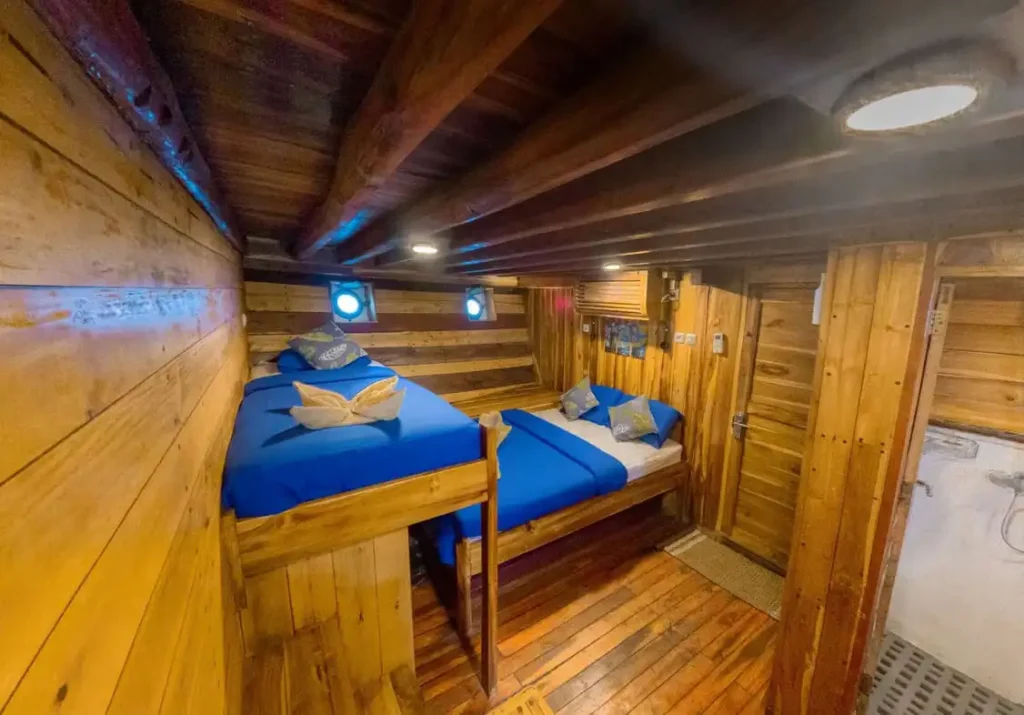
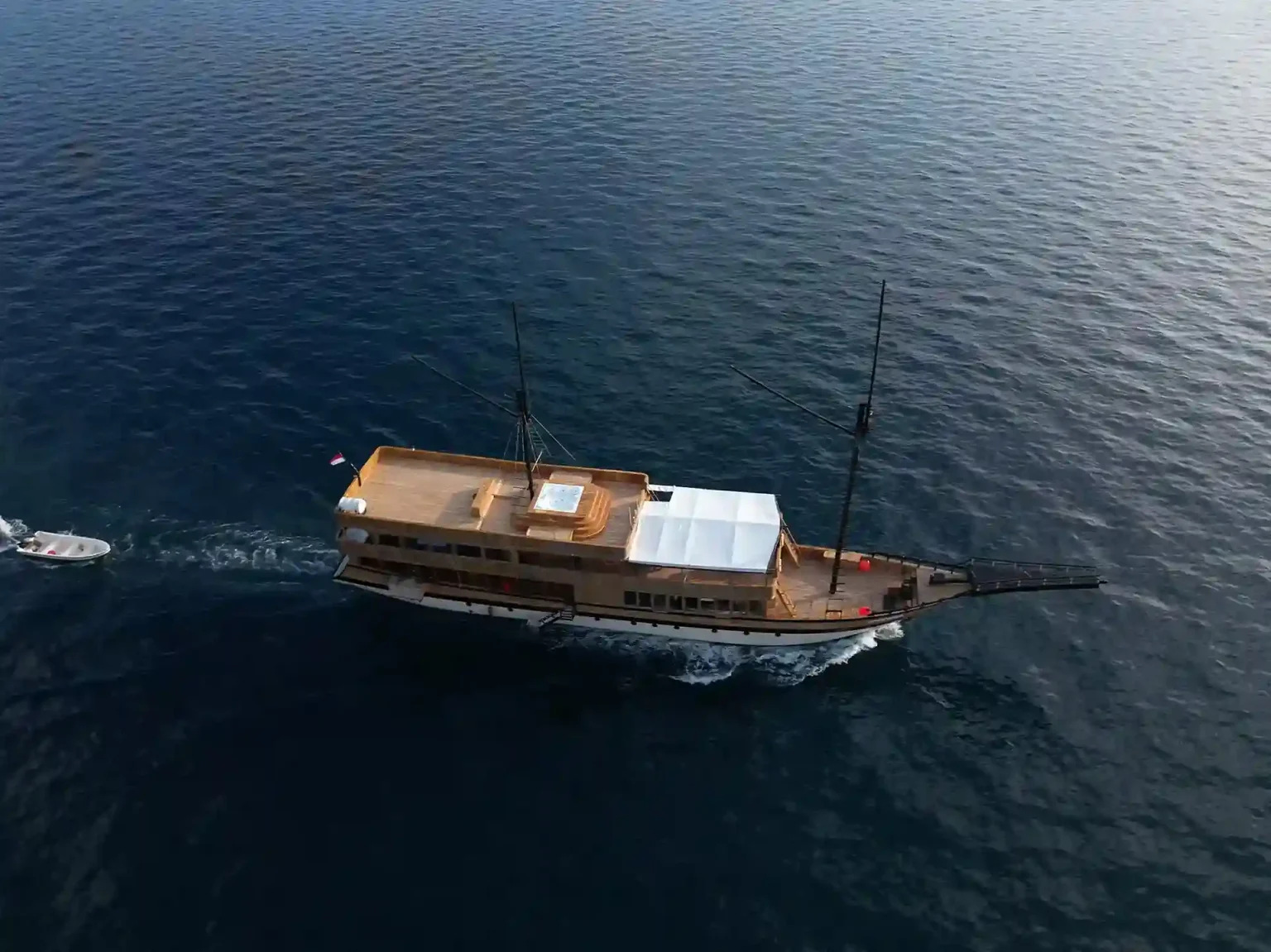
On a boat where every cabin is the same, split equally and be done. The question only gets interesting on vessels with mixed cabins. Our own fleet illustrates the spread: Lamborajo I sleeps up to 24 across six cabins with shared bathrooms, while Lamborajo II and III give every cabin its own. When one couple takes the biggest cabin with the picture window and two singles take upper bunks, a flat split starts to feel wrong.
The clean method, used by groups that have done this before:
- Price the boat equally. Everyone pays the same base share of the charter — the deck, the crew, the meals and the itinerary are identical for all.
- Auction the cabin difference. Agree a premium for the best one or two cabins — say USD 30–50 per person — and subtract the pot evenly from everyone else’s share. Whoever values the window pays for the window.
- Keep non-boat costs out of the split. Park fees (IDR 250,000 regulated entrance per foreign visitor), flights, alcohol and crew gratuities are individual, not communal.
The empty-bed problem
Someone always drops out three weeks before departure. Decide in advance which of the two honest rules applies: the dropper forfeits their deposit and the group absorbs the difference, or the dropper remains liable for their share until a replacement is found. Both are defensible; announcing the rule after the dropout is what breaks friendships. Because charter tiers step at 12, 16 and 20 guests, losing one person sometimes costs nothing at all — check whether your new headcount still sits in the same tier before anyone panics. Our small group vs big boat cost table shows how sharply the per-head number moves at each tier edge.
Collecting the money without becoming the villain
- One treasurer, one ledger. A shared spreadsheet with names, deposits and balances, visible to all. Venmo-style trickles into a personal account create suspicion; transparency removes it.
- Collect the deposit the day the date is held. Operators confirm deposit terms in writing when they hold your boat; mirror that deadline inside the group.
- Build a 5 percent buffer. Fuel for a route change, an extra crate of drinks in Labuan Bajo, a tip pool for the crew. Refund whatever is left on the last night — the buffer that comes back is the one nobody resents.
A worked example, start to finish
Sixteen friends, 3D2N, Lamborajo II: the 13–16 tier is USD 7,150, so the base share is USD 447 each. The group agrees the two best cabins carry a USD 40 premium per occupant; four people pay USD 487 and the pot of USD 160 comes off the other twelve shares, dropping them to about USD 434. Each traveller separately budgets the regulated park entrance (IDR 250,000 for foreign visitors, IDR 50,000–75,000 for Indonesians), their own flights, and roughly USD 15–20 toward the crew tip pool. The treasurer collects a 30 percent deposit into the shared ledger the week the date is held, the balance a month before sailing. Nobody argues, because every number was written down before anyone packed.
Quick answers
Should couples pay more than singles sharing?
Not for the boat itself — a berth is a berth. Couples occupying a private double on a boat where others share four-berth cabins are the textbook case for the cabin premium: keep the base equal, price the privacy.
What about friends who join late?
If the newcomer pushes the group into a higher tier, the tier difference is theirs to absorb before the split is recalculated; if they slot into an existing tier, they simply pay the current share. Late joiners lower everyone’s cost or leave it unchanged — they should never raise it.
If your group is still deciding between vessel classes across the wider harbour, the Komodo boat charter network catalogue shows what sits above and below this fleet. And when the spreadsheet is ready and the headcount is honest, send it to the reservations desk on WhatsApp — they will tell you which tier you land in and hold the date while the treasurer does the collecting.
Whole-boat rates used for this kind of split are published as Komodo yacht charter prices, updated each season by the operator.
Send your dates and group size — the reservations desk replies with live availability and the current rate.
Keep reading
 A Working Rundown for a Two-Day Staff Gathering on a Komodo Boat
Planning & Costs
A Working Rundown for a Two-Day Staff Gathering on a Komodo Boat
Planning & Costs
 How Far in Advance Should a Group of 20 Book a Komodo Boat for 2027?
Planning & Costs
How Far in Advance Should a Group of 20 Book a Komodo Boat for 2027?
Planning & Costs
 Per-Seat vs Per-Cabin Pricing on Komodo Open Trips, Explained
Planning & Costs
Per-Seat vs Per-Cabin Pricing on Komodo Open Trips, Explained
Planning & Costs
 Which Airlines Fly to Labuan Bajo (Komodo Airport), and Where From?
Planning & Costs
Which Airlines Fly to Labuan Bajo (Komodo Airport), and Where From?
Planning & Costs